Think back to the diagram in your school biology textbook. A uterus shaped like a bull’s head, two ovaries, a vagina. And the clitoris? At best a dot, named in passing. At worst, nothing at all.
You grew up with that drawing. So did almost every woman of your generation. And the omission is far from trivial: it shaped the way millions of women understood — or failed to understand — their own pleasure.
An organ ten centimetres long
What you can see of the clitoris is its glans: a few millimetres beneath a small hood of skin, at the top of the vulva. For a long time, people believed that was all there was. It is only the tip.
The rest lies inside the body, invisible to the naked eye:
- the body of the clitoris, which extends the glans upwards before folding back;
- two legs, which spread apart like the arms of a V and run along the pelvic bone, up to nine centimetres long;
- two bulbs, which surround the entrance to the vagina, nestled beneath the outer lips.
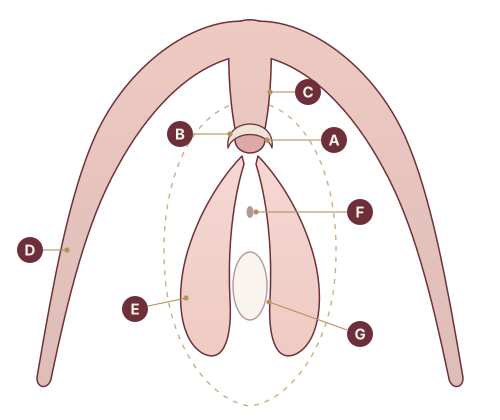
- The glans, the only visible part
- The hood, a fold of skin
- The body
- The two legs, up to nine centimetres long
- The two bulbs, beneath the outer lips
- The urethral opening
- The vaginal opening
In all, the clitoris measures around ten centimetres on average. The body, the legs and the bulbs are erectile tissue: with arousal, they fill with blood and swell. This is sometimes called, quite rightly, female erection.
This is not an image. It is anatomy, as we know it today.
A discovery that came so late
In 1844, a German anatomist, Georg Ludwig Kobelt, had in fact drawn these structures with great precision. Then that knowledge was lost — or rather, people stopped passing it on. For more than a century, medicine largely ignored the organ of female pleasure.
It was not until 1998 that the Australian urologist Helen O’Connell published a complete description of the clitoris, and 2005 before she confirmed its structure by MRI, in ten volunteers. The clitoris appears there as what it is: a cluster of erectile tissue organised around the urethra and the vagina.
In France, the public turning point came from an independent researcher, Odile Fillod. In 2016, she modelled a life-size clitoris that could be 3D-printed, and made it freely available. In 2017, the publisher Magnard became the first to show the complete clitoris in a school biology textbook. At the time, other publishers left it out, mentioned it without drawing it, or reduced it to an organ a few millimetres long.
In other words: if you are over twenty-five, there is a good chance nobody ever showed you your own anatomy.
More than ten thousand nerve fibres
For decades, one figure did the rounds: the clitoris was said to have 8,000 nerve endings. You read it everywhere. In 2022 it emerged that it probably came from studies carried out… on livestock.
That year, a team at Oregon Health & Science University led by the surgeon Blair Peters carried out the first count in humans. The result: around 10,281 nerve fibres in the clitoris’s dorsal nerve alone — 20% more than the accepted figure. And that is not the whole clitoris: other, smaller nerves come on top.
This figure does not only say that the clitoris is sensitive. It says that it took until the twenty-first century for anyone to take the trouble to measure it.
What this changes for pleasure
This rediscovered anatomy has very concrete consequences.
It dissolves an old false debate. In 1905, Freud claimed that a “mature” woman should move on from clitoral pleasure, deemed infantile, to vaginal pleasure. Generations of women felt incomplete for not managing it. We now know that the bulbs and legs of the clitoris surround the vagina, and that the front wall of the vagina, the clitoris and the urethra form an area that works as one. Researchers speak of the clitourethrovaginal complex. Setting “clitoral” against “vaginal” therefore makes little sense: it is, to a large extent, the same organ, reached by different paths. I come back to this in G-spot, sacred spot: what science says.
It explains why women’s pleasure takes time. Ten centimetres of erectile tissue do not fill with blood in a few seconds. Arousal is a process, not a switch. You are not “slow”: your anatomy needs to be allowed to awaken.
It reminds us that the whole body matters. The clitoris is linked to a nervous network that does not stop at the sex. A long massage of the back, the thighs, the belly is not a preamble: it is already part of the way.
What this changes in a yoni massage
This anatomy is what guides the way I practise yoni massage.
Massaging the vulva does not mean focusing on the glans alone, which is too sensitive to be approached straight away. First, it envelops. A palm resting on the pubis. Slow pressure on the outer lips, which reaches the bulbs beneath. Strokes that follow the legs, on either side. The glans comes later, once everything else has awakened.
And when the massage moves inside, if you have asked for it, the front wall of the vagina offers another path to the root of the clitoris. It is one of the differences I explain in External or internal yoni massage: what changes.
None of this is a secret technique. It is simply anatomy, taken seriously.
An organ worth knowing, at last
The clitoris is not a detail of your body. It is a whole organ — rich, largely hidden, and devoted entirely to pleasure. Knowing it already changes the way you see your own desire.
If you would like to go further, the point-by-point exploration of yoni mapping lets you discover how your body, yours in particular, responds. And for any question, I am available on +33 7 43 54 47 87, between Aix-les-Bains and Chambéry, in English if you prefer.
No one showed you your whole body. It is never too late to discover it.